November 5, 2026
How to Find Affordable GPT-6 Access Through Smart API Routing
By @uberllmaffordablegpt6haven
The launch of each new generation of large language models brings a familiar tension. The technology gets smarter, more reliable, and more capable. But the price often climbs just as fast. GPT-6, if and when it arrives, will almost certainly follow this pattern. The question for developers, startups, and even mid-size companies is not whether the model will be good. It is whether they can use it without blowing their budget.
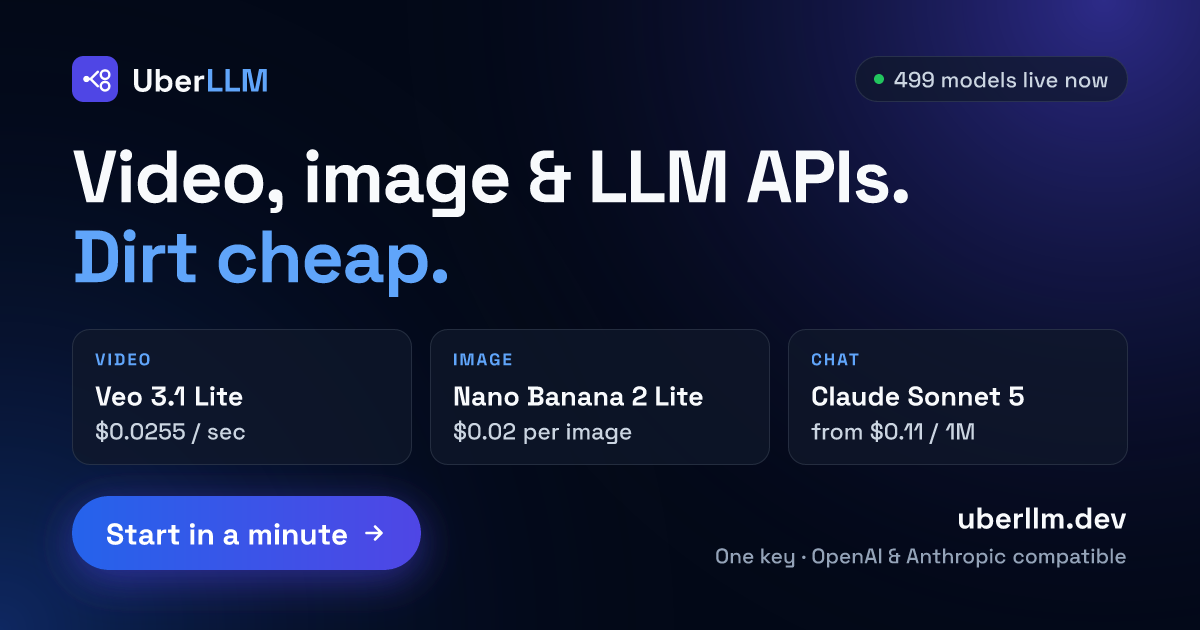
There is already a way to think about this problem before the model even ships. The key lies not in waiting for a single provider to lower its price, but in changing how you buy access in the first place. Instead of going to one source, you can route requests through a marketplace that aggregates multiple sellers. That is the idea behind platforms like UberLLM, and it is exactly the kind of model that makes affordable GPT-6 access possible from day one.
The Problem with Direct API Purchasing
When you buy API access directly from a model provider, you pay whatever list price they set. That price covers their infrastructure costs, their margin, and their overhead. It also assumes you are a generic customer. You might be a small team running a handful of requests, or you might be a large operation doing millions of calls a day. Either way, you pay the same per-token rate.
This flat pricing structure leaves a lot of money on the table for heavy users, and it locks out smaller teams who cannot commit to large prepaid contracts. The providers have little incentive to offer granular pricing tiers because they control the whole stack. They own the hardware, the model weights, and the API endpoint. There is no competition at the point of sale.
That changes when you introduce a marketplace layer. Sellers with spare capacity or lower operational costs can offer the same model at a discount. They compete on price, reliability, and latency. The buyer gets the same model output, sometimes from the same underlying hardware, but at a lower cost. This is not a hypothetical. It is already how many teams access GPT-4 and other large models today.
What Affordable GPT-6 Access Actually Requires
Let us be realistic about what "affordable" means for a model of GPT-6's expected scale. The training compute alone will be staggering. Inference costs will be higher than current models, at least initially. A single query could cost ten or twenty times what an equivalent GPT-4 query costs today. That puts real pressure on any application that relies on frequent calls.
Affordable access in this context does not mean cheap. It means cost-effective relative to the value the model delivers. If a model can automate a task that previously required a human specialist, paying a few cents per call is still a bargain. But the margin for error shrinks. Every wasted token, every unnecessary retry, and every premium-priced call eats into that value.
This is where routing matters. A marketplace platform can send your request to the seller that offers the best current price for GPT-6, provided that seller meets your latency and reliability requirements. You do not have to chase down deals or negotiate separate contracts. The platform handles the matching. You just send one request to one endpoint and get back the best available rate.
That is the core of what uberllm affordable gpt-6 access looks like in practice. You integrate once, and the platform does the work of finding a seller who can serve the model at a price that makes sense for your use case. It is not magic. It is just competitive routing applied to AI infrastructure.
How Marketplace Routing Lowers Costs
Competitive routing works because sellers in a marketplace have different cost structures. Some run their own inference hardware and have idle capacity during certain hours. Some buy compute in bulk and resell it at thin margins. Some focus on specific geographies where energy or hardware costs are lower. All of them want to keep their utilization high. A marketplace lets them bid for your traffic without you having to run an auction yourself.
From the buyer's perspective, the main benefit is optionality. You are not locked into one provider's pricing trajectory. If the official GPT-6 API raises prices, you can shift more traffic to alternative sellers. If a new seller enters the market with better infrastructure, you can benefit from that competition immediately. You do not have to renegotiate or rewrite your integration.
There are trade-offs, of course. Not every seller offers the same quality of service. Latency can vary. Some sellers might cache responses or apply different safety filters. A good marketplace gives you visibility into these differences and lets you set thresholds. You might accept a slightly slower response for a 20 percent lower price, or you might pay a premium for the fastest route. The control stays with you.
Practical Considerations Before You Start
If you plan to rely on a marketplace for GPT-6 access, there are a few things to think about ahead of time.
- Understand your own traffic patterns. Steady, predictable volume is easier to route cheaply than sporadic bursts. Sellers like consistent load because it helps them plan capacity. If your usage is highly variable, you may pay a bit more for the flexibility.
- Decide what latency you can tolerate. Some sellers will offer lower prices by running on slower hardware or by batching requests. If your application needs real-time responses, you will need to filter for sellers that can guarantee low latency. That might reduce the pool of available sellers and raise the floor price.
- Check the marketplace's fallback behavior. What happens if the cheapest seller goes down or becomes too slow? A good platform will automatically fail over to the next best option. You should know the failover logic and test it before you go to production.
- Look at the authentication and security model. You are sending your prompts and receiving model outputs through a third-party routing layer. Make sure the marketplace does not log your data or share it with sellers in a way that violates your privacy requirements. Some platforms offer encryption or data masking options.
These are not reasons to avoid marketplaces. They are just the normal due diligence you would do with any infrastructure vendor. The savings can be substantial, but only if you set up your integration with awareness of how the routing works.
What to Expect as GPT-6 Rolls Out
When GPT-6 first becomes available, the official API will likely be the only option for a short period. Sellers need time to set up their own inference stacks, and the model's hardware requirements might limit who can run it. But the marketplace model tends to catch up quickly. Within weeks or months, multiple sellers will offer the model at competitive rates.
During that early window, it pays to have your integration ready. If you already use a platform like UberLLM, you can start routing requests to GPT-6 as soon as any seller offers it. You do not need to sign a new contract or get approval from a sales team. You just add the model to your existing workflow. That speed alone can be a competitive advantage.
Over time, the price gap between the official API and marketplace sellers will likely widen. The official provider has to maintain a single price that works for their entire customer base. Sellers can be more aggressive because they target specific niches. The result is that users who rely on a marketplace will consistently pay less, especially as the model matures and sellers find ways to optimize their inference costs.
This is not a prediction that the official API will be overpriced. It is just a reflection of how markets work. When multiple parties compete to serve the same demand, prices tend to move toward the marginal cost of the most efficient provider. The buyer benefits from that competition. And because the marketplace abstracts away the complexity of dealing with multiple sellers, you get the benefit without the operational headache.
Putting It All Together
For anyone building on top of large language models, the ability to get affordable GPT-6 access will determine which projects are viable and which remain stuck in prototype. The cost of inference is not going to zero. But it does not have to be a barrier either. The smart approach is to build your infrastructure around the idea of choice. Use a single integration point that lets you switch between sellers as costs and capabilities change.
That is exactly what uberllm affordable gpt-6 access offers. You connect once, and the platform handles the routing, the seller selection, and the price optimization. You focus on your product, not on managing API keys and contracts with a dozen different providers.
If you are already using a marketplace for current-generation models, the transition to GPT-6 will be seamless. If you are not, the time to start is before the model launches. Set up your integration, test it with existing models, and get comfortable with the routing logic. Then when GPT-6 arrives, you will be ready to use it at a price that makes sense for your business, without waiting for a price drop that may never come from the official source.
The bottom line is that affordable access to frontier models is not about hoping for cheaper compute. It is about designing your architecture to take advantage of market dynamics. A marketplace platform is the most direct way to do that today, and it will only become more valuable as models get larger and more expensive to run.
By the time you read this, someone will already be running GPT-6 through a marketplace at a fraction of the list price. That is the reality of competitive routing. And it is why thinking about uberllm affordable gpt-6 access now, before the model is even in your hands, is the smartest move you can make.
❧